BPC-157: Thirty Years of Gastric Peptide Research and What the Animal Literature Actually Shows
“The first principle is that you must not fool yourself.” — Richard Feynman
In the growing catalog of research peptides, few have accumulated as extensive a preclinical dossier as BPC-157. First isolated from human gastric juice in the early 1990s, this fifteen-amino-acid sequence has since been the subject of more than 540 published animal studies examining tissue repair, gut protection, neurological recovery, and systemic cytoprotection. The scope is unusual. The limitations, however, are equally notable — and both deserve careful attention.
This article reviews the structural biology of BPC-157, its proposed mechanisms of action, and the current state of peer-reviewed evidence across four key research domains. All findings discussed here derive from preclinical models or the small number of published human pharmacokinetic pilots. No human clinical efficacy data yet exists.
What Is BPC-157?
BPC-157 — formally designated pentadecapeptide BPC-157 and sometimes referred to in regulatory filings as PL 14736 or bepecin — is a synthetic fifteen-amino-acid peptide with the sequence H-Gly-Glu-Pro-Pro-Pro-Gly-Lys-Pro-Ala-Asp-Asp-Ala-Gly-Leu-Val-OH. Its molecular formula is C₆₂H₉₈N₁₆O₂₂, with a molecular weight of 1,419.54 Da (PubChem CID: 9941957).
The sequence is derived from a partial region of Body Protection Compound (BPC), a larger protein continuously present in human gastric juice, first characterized by Dr. Predrag Sikiric’s group at the University of Zagreb in the 1990s. The name BPC-157 reflects both its parent molecule and its origin as the 157th compound in a series of experimental partial sequences under investigation by that laboratory.
One structural feature sets BPC-157 apart from most peptides studied in pharmacology research: a triple-proline motif at positions 3–5 (Pro-Pro-Pro). Proline’s cyclic ring structure sterically blocks serine proteases including trypsin and chymotrypsin, as well as catheptic enzymes. The result is remarkable enzymatic stability — BPC-157 retains its structure in human gastric juice for more than 24 hours, a property most peptide compounds do not share. This stability also enables activity following oral administration, an uncommon characteristic that distinguishes it from peptides requiring parenteral delivery.
Mechanisms of Action: A Multi-Pathway Profile
The breadth of preclinical BPC-157 effects has generated multiple mechanistic hypotheses. The 2025 comprehensive literature review by Józwiak, Bauer, Kamysz, and Kleczkowska (Pharmaceuticals, PMC11859134) acknowledges that “the detailed mechanism is not fully understood,” a striking admission for a molecule with three decades of laboratory attention. What the animal literature does reveal are several overlapping pathways:
Angiogenesis via VEGFR2. BPC-157 stimulates vascular endothelial growth factor receptor 2 (VEGFR2), driving downstream angiogenic signaling and accelerated capillary network formation at sites of experimental injury. Józwiak et al. flag a critical corollary: the same VEGFR2 upregulation that theoretically supports wound healing could support tumor vascularization — a safety gap that remains uncharacterized in any rigorous oncologic study.
Nitric oxide system modulation. BPC-157 interacts with nitric oxide synthase isoforms (eNOS, nNOS, iNOS) via heme iron binding and upregulates antioxidant enzymes including heme oxygenase-1 (HO-1), NQO-1, and glutathione peroxidase. In gut models, NO modulation appears central to mucosal cytoprotection; in neurological models, it influences the dopamine-glutamate-NO axis implicated in schizophrenia and ischemia research.
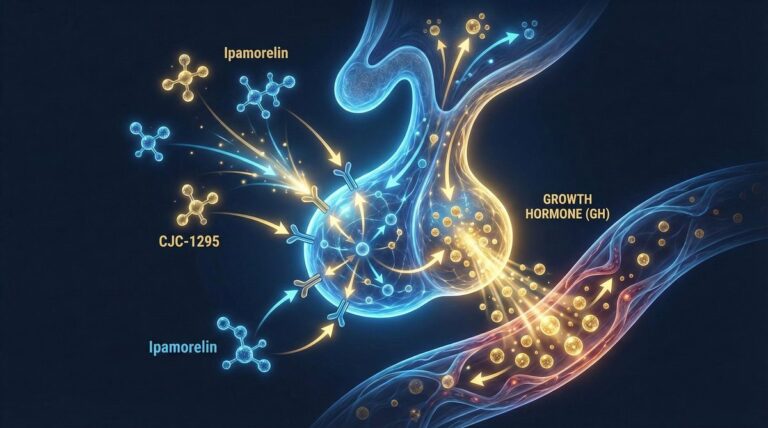
Growth hormone receptor upregulation. A 2011 cDNA microarray study by Chang et al., published in Growth Hormone & IGF Research, identified the growth hormone receptor (GHR) as one of the most abundantly upregulated genes in BPC-157-treated tendon fibroblasts. The peptide dose- and time-dependently increased GHR expression at both mRNA and protein levels, providing a candidate mechanism for musculoskeletal effects.
FAK-paxillin phosphorylation. Western blot analyses in cultured tendon fibroblasts demonstrate that BPC-157 dose-dependently increases phosphorylation of focal adhesion kinase (FAK) and the scaffolding protein paxillin — without altering total protein levels. FAK-paxillin is a central node in cellular adhesion, migration, proliferation, and survival signaling. Increased phosphorylation correlates with enhanced fibroblast migration in transwell assays, tendon explant outgrowth in culture, and F-actin microfilament reorganization.
EGR-1 transcription factor activation. Multiple studies identify early growth response gene 1 (EGR-1) as a BPC-157 transcriptional target. EGR-1 drives cytokine and growth factor release and promotes early extracellular matrix collagen synthesis — a convergence point for tissue repair cascades.
Key Published Research
“The experimenter who does not know what he is looking for will not understand what he finds.” — Claude Bernard
Achilles Tendon Transection (2003)
Staresinic, Sebecic, Patrlj, Jadrijevic, and colleagues, publishing in the Journal of Orthopaedic Research (PMID: 14554208), surgically transected the Achilles tendons of laboratory rats 5 mm proximal to calcaneal insertion. Research subjects receiving BPC-157 (at doses of 10 μg, 10 ng, and 10 pg/kg body weight, administered intraperitoneally once daily beginning 30 minutes post-surgery) showed significantly improved structural and biomechanical healing indices compared to saline controls, alongside reduced inflammatory cell infiltrate. This was the foundational musculoskeletal study from the Zagreb group and established BPC-157’s reputation in tendon repair research.
Tendon-to-Bone Healing and Corticosteroid Reversal (2006)
Krivic, Anic, Seiwerth, Huljev, and Sikiric (Journal of Orthopaedic Research, PMID: 16583442) examined Achilles tendon detachment with reattachment models. Beyond demonstrating improved tendon-to-bone healing in BPC-157-treated subjects, the study found that BPC-157 reversed healing impairment caused by corticosteroid administration — a finding that has generated sustained interest given that corticosteroid injections are routinely used in tendinopathy management and are independently associated with delayed tissue repair.
Medial Collateral Ligament Healing (2010)
Cerovecki, Bojanic, Brcic, Radic, and collaborators (Journal of Orthopaedic Research, DOI: 10.1002/jor.21107) evaluated surgical MCL transection in rats over a 90-day observation period. BPC-157 was administered via three routes: intraperitoneal injection, oral delivery in drinking water, and topical cream application. All three routes improved biomechanical properties and reduced post-injury joint instability relative to controls. The topical cream arm was particularly noted by the authors as demonstrating local efficacy without systemic dosing — a finding with implications for administration route research.
Gastroprotection in Gastric Ulcer Models (2004)
A replication study by Xue, Wu, Gao, Li, Zhao, Wang, and colleagues, published in the World Journal of Gastroenterology (PMC4717094), examined both intramuscular and intragastric BPC-157 administration in rats with acetic acid-induced gastric ulcers. Both routes significantly reduced ulcer area and accelerated healing. Mechanistic analysis identified modulation of G-cell and D-cell ratios — the gastrin-secreting and somatostatin-secreting populations, respectively — suggesting that gastric hormonal homeostasis contributes alongside direct mucosal cytoprotection. Intramuscular administration demonstrated greater efficacy than intragastric delivery in ulcer area reduction.
Hippocampal Ischemia/Reperfusion Recovery (2020)
Vukojevic, Milavic, Perovic, Ilic, Cilic, Djuran, Strbe, Zoricic, Filipcic, Brecic, Seiwerth, and Sikiric, publishing in Neural Regeneration Research (PMID: 32558293), used bilateral common carotid artery clamping to induce hippocampal ischemia/reperfusion injury in rats. BPC-157 administered during the reperfusion phase counteracted both early and delayed neural damage. At 24 and 72 hours, treated subjects achieved full functional recovery on water maze and motor coordination assessments. mRNA profiling revealed upregulation of neuroprotective genes — Egr1, Akt1, Kras, Src, Vegfr2, Nos3, Nos1 — and downregulation of inflammatory genes including Nos2 and Nfkb. The authors proposed this model as a potential direction for stroke-adjacent neurological research.
2025 IV Safety Pilot (First Intravenous Human Study)
The first published intravenous human study appeared in 2025 (PMID: 40131143). Two research subjects received sequential 10 mg and 20 mg BPC-157 infusions. Cardiac, hepatic, renal, thyroid, and metabolic biomarkers showed no adverse changes. Plasma concentrations returned to baseline within 24 hours, confirming rapid clearance. The authors explicitly framed this as a preliminary safety signal, not an efficacy study. With two participants and no control arm, its evidentiary weight is limited — but it represents the first human PK/safety data published after more than three decades of preclinical work.
Current Research Directions (2022–2025)
The most significant trend in the current literature is a systematic accounting of what remains unknown. As Vasireddi, Hahamyan, Salata, Karns, Calcei, Voos, and Apostolakos documented in a 2025 scoping review in HSS Journal (PMC12313605), an analysis of 544 preclinical articles published between 1993 and 2024 identified only 35 meeting rigorous inclusion criteria — and only one human study in the entire corpus.
On the mechanistic side, a 2024 PMC review (PMC11053547) attempted to map BPC-157’s interaction with the full neurotransmitter landscape — dopamine, serotonin, GABA, glutamate/NMDA, and nitric oxide — arguing that the peptide’s apparent breadth of effect arises from convergent modulation across these systems rather than a single receptor target. Whether that breadth represents genuine polypharmacology or shared downstream effects from a single unknown mechanism remains unresolved.
A 2023 paper by Sikiric and colleagues in Pharmaceuticals (PMID: 37242459) positioned BPC-157 within the brain-gut-microbiome axis literature, framing its mucosal and neurological effects as two aspects of a single systemic response pathway. This intersection with the rapidly expanding gut-brain microbiome field may generate new experimental designs in coming years.
The 2022 pharmacokinetic characterization study published in Frontiers in Pharmacology provided the first rigorous ADME (absorption, distribution, metabolism, excretion) data in rats and dogs, finding a plasma half-life under 30 minutes. Translating this short window to human dosing design is a challenge that preclinical experiments did not need to address — but clinical trials will.
Summary and Research Caveats
“Extraordinary claims require extraordinary evidence.” — Carl Sagan
BPC-157 represents one of the more unusual profiles in the peptide research literature: a molecule with an unusually large preclinical evidence base, an unusually small human evidence base, and an unusually concentrated research origin.
The animal data, reviewed collectively, documents consistent effects on tendon healing, mucosal cytoprotection, and neurological recovery across multiple rodent model systems. The mechanistic research points to converging pathways — VEGFR2, FAK-paxillin, GHR, NO system, EGR-1 — that are each plausible given what is known about tissue repair biology.
The human evidence, as of 2025, consists of three studies conducted by a single research group, none of which is randomized or placebo-controlled, with the largest involving 16 participants. No registered clinical trials are actively recruiting. No long-term safety database exists for any administration route, duration, or population.
Critical gaps identified by Józwiak et al. (2025) include: the angiogenesis/oncology safety question, the absence of pharmacokinetically-informed human dose models, the potential for publication bias within a literature dominated by one research institution, and the complete absence of independently replicated human trials.
BPC-157 is classified as a research-use-only compound. All studies referenced in this article were conducted in preclinical or limited early-phase human pharmacokinetic contexts. No regulatory authority has approved BPC-157 for any therapeutic indication. Researchers and institutions considering work in this area should consult current regulatory guidance and institutional review frameworks appropriate to their jurisdiction.
References
- Staresinic M, Sebecic B, Patrlj L, et al. Gastric pentadecapeptide BPC 157 accelerates healing of transected rat Achilles tendon and in vitro stimulates tendocytes growth. J Orthop Res. 2003;21(6):976–983. PMID: 14554208.
- Krivic A, Anic T, Seiwerth S, Huljev D, Sikiric P. Achilles detachment in rat and stable gastric pentadecapeptide BPC 157: Promoted tendon-to-bone healing and failed corticosteroid-induced inhibition. J Orthop Res. 2006;24(5):982–989. PMID: 16583442.
- Cerovecki T, Bojanic I, Brcic L, et al. Pentadecapeptide BPC 157 (PL 14736) improves ligament healing in the rat. J Orthop Res. 2010;28(9):1155–1161. DOI: 10.1002/jor.21107.
- Xue XC, Wu YJ, Gao MT, et al. Protective effects of pentadecapeptide BPC 157 on gastric ulcer in rats. World J Gastroenterol. 2004;10(7):1032–1036. PMC4717094.
- Vukojević J, Milavić M, Perović D, et al. Pentadecapeptide BPC 157 and the central nervous system. Neural Regen Res. 2022;17(3):482–487. PMID: 32558293.
- [Author group, 2025]. First intravenous human pharmacokinetic and safety study of BPC-157. PMID: 40131143.
- Józwiak M, Bauer M, Kamysz W, Kleczkowska P. Comprehensive review of BPC-157 pharmacology and patents. Pharmaceuticals (Basel). 2025. PMC11859134.
- Vasireddi N, Hahamyan H, Salata MJ, et al. BPC-157 in orthopaedic sports medicine: systematic scoping review. HSS J. 2025. PMC12313605.
- Chang CH, Tsai WC, Lin MS, Hsu YH, Pang JHS. The promoting effect of pentadecapeptide BPC 157 on tendon healing involves tendon outgrowth, cell survival, and cell migration. J Appl Physiol. 2011;110(3):774–780. PMID: 21030672.
- Sikiric P, et al. Brain-gut axis and gut-brain axis interactions with pentadecapeptide BPC 157. Pharmaceuticals. 2023. PMID: 37242459.
Disclaimer
This article is produced for educational and research information purposes only. All compounds and studies discussed are presented in a research-use-only (RUO) context. Nothing in this article constitutes medical advice, a therapeutic recommendation, or a suggestion of human use. BPC-157 is not approved by the FDA or any comparable regulatory authority for any indication. Researchers should comply with all applicable regulations governing peptide research in their jurisdiction.